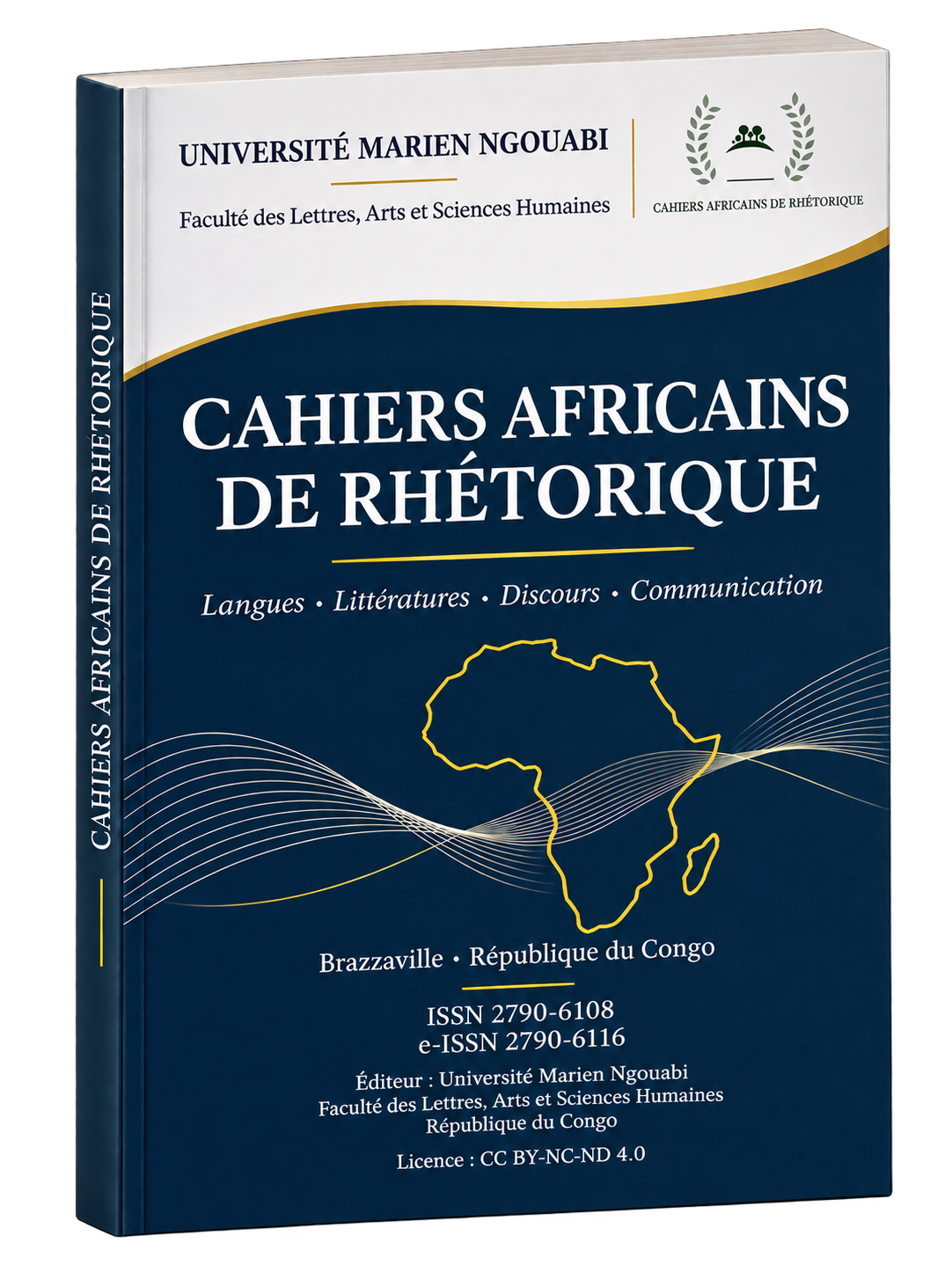
Couverture des Cahiers Africains de Rhétorique : logo, éditeur Université Marien Ngouabi — FLASH, République du Congo ; licence CC BY-NC-ND 4.0

About the Journal

EDITORIAL POLICY

Cahiers Africains de Rhétorique is a scholarly journal publishing research in discourse analysis, linguistics, stylistics, literature and communication. From 2026, it will publish thematic issues. It applies the code of research ethics and professional conduct in force within the African and Malagasy Council for Higher Education (CAMES).

The journal welcomes contributions from researchers worldwide who analyse the linguistic, rhetorical and communicational aspects of Africa. It covers the language sciences and related disciplines:

  • linguistics;
  • stylistics;
  • discourse analysis;
  • literature;
  •  

Mission and Objectives

The journal’s mission is to publish high-quality work based on African oral and textual corpora in discourse analysis, linguistics and literature. It aims to be international and also accepts original articles from other parts of the world, provided they fall within its editorial policy.

Its objectives are as follows:

  1. to help researchers in the CAMES area gain access to high-quality scholarly publication;
  2. to ensure rigorous scientific evaluation of submitted work, excluding submissions that do not meet the requirements of relevance and quality;
  3. to publish articles that make a significant and relevant contribution to the disciplines covered.

Open Access and Copyright

© Cahiers Africains de Rhétorique is a journal of Marien Ngouabi University. It follows a policy of open access to scientific and technical information: the editorial policy and articles are available online, and any commercialisation of articles is strictly prohibited. Articles must be cited in accordance with the CAMES Intellectual Property Code.

In scientific cooperation with researchers from CAMES universities, the journal complies with the Ethical, Editorial and Confidentiality Charter of this organisation and its strictest standards.

Author Responsibility and Ethics

The opinions expressed in the articles fall within the framework of scientific debate and are the sole responsibility of their authors.

In accordance with the CAMES ethical and professional rules in force for research, any scientific misconduct will be reported to the author’s academic and professional institutions. Misconduct includes in particular:

  • plagiarism and self-plagiarism;
  • submission of artificially generated texts;
  • withdrawal of a submitted article without prior notification to the Editorial Board.

Any non-compliant procedure results in automatic rejection of the text and termination of the collaboration.

Current Issue

Vol. 5 No. 1 (2026): The rhetorical techniques of diplomatic language
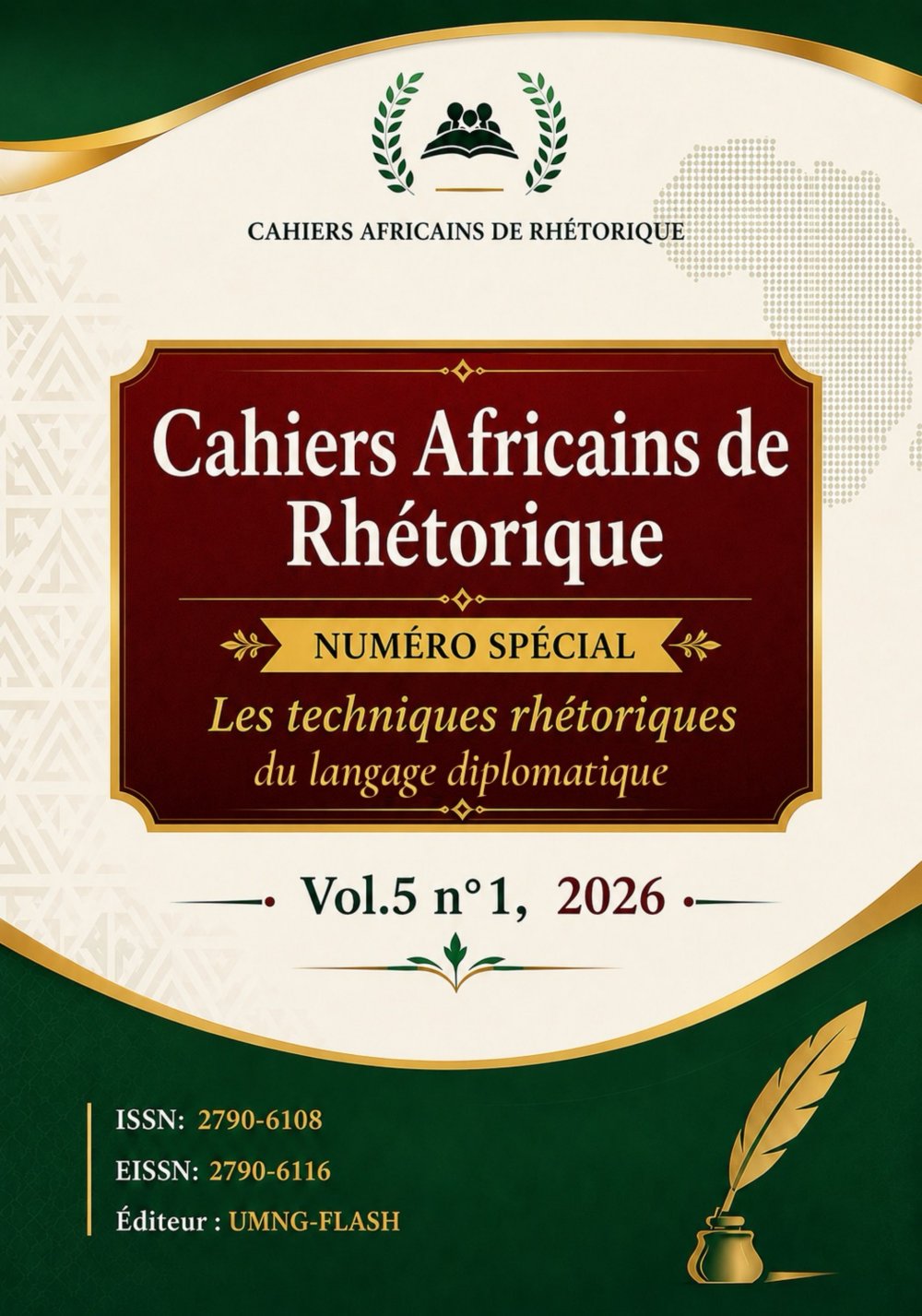
					View Vol. 5 No. 1 (2026): The rhetorical techniques of diplomatic language

This issue is devoted to the diplomatic language in the world.

Published: 2026-08-25

Full Issue

Articles

  • Sommaire

    1-17
    DOI: https://doi.org/10.55595/f0rh8096
    Views: 621Downloads: 173
  • Multidimensional Analysis of the Closing Speech of Candidate Denis Sassou Nguesso: Between Stateism, Stability and Modernity

    Odzotto Gandron (Auteur·e)
    18-26
    DOI: https://doi.org/10.55595/ye92hb75CAR2026
    Views: 421Downloads: 167
  • Linguistic Aspects of Diplomatic Language in Vladimir Putin’s Speeches: An Analysis of Discursive and Rhetorical Strategies

    Arsène Elongo (Auteur·e)
    27-53
    DOI: https://doi.org/10.55595/14zek912CAR20261
    Views: 1198Downloads: 295
    Données ouvertes
  • An enunciative and rhetorical study of the "diplomatic 'we'" based on the case of Denis Sassou N'Guesso: Major speeches from the first seven-year term (2002–2009) Claudia Lemboumba Sassou N'Guesso

    Ngamountsika Edouard (Auteur·e)
    54-66
    DOI: https://doi.org/10.55595/dbv29v70CAR2026
    Views: 1095Downloads: 209
  • Breaking protocol: anticolonial rhetoric and diplomatic speech at Lumumba and Sankara

    Nombo Augustin (Auteur·e)
    67-84
    DOI: https://doi.org/10.55595/0tak7r34CAR2026
    Views: 754Downloads: 156
  • Diplomatic language as colonial memory: protocol, Gaullist rhetoric, and counter-discourse in Guy Menga's Case de Gaulle

    Moukoukou Sidoine Romaric (Auteur·e)
    85-100
    DOI: https://doi.org/10.55595/rr1q0s40CAR23
    Views: 692Downloads: 159
  • Diplomacy through Speech: Mbochi Tradition and the Sassou N'Guesso Doctrine in the Congo (1979–2026)

    Gomas Aimée Noelle (Auteur·e)
    102-117
    DOI: https://doi.org/10.55595/gnmw8f09CAR1
    Views: 823Downloads: 242
  • Hyperbole in Donald Trump’s diplomatic language

    Ange Loumbouzi Didier Arcade (Auteur·e)
    118-140
    DOI: https://doi.org/10.55595/eq316q93
    Views: 510Downloads: 165
  • Trump, or the breaking of diplomatic codes in political language

    Miatékéla Othon Chrysostome, Mambouana Petou Raphice Graçadieu (Auteur·e)
    141-162
    DOI: https://doi.org/10.55595/0tfqsh83
    Views: 814Downloads: 288
  • Aspects of Diplomatic Stylistic Devices in the Speeches of Jean-Claude Gakosso

    Dzaboua Monkala (Auteur·e)
    163-175
    DOI: https://doi.org/10.55595/esrn9836car25
    Views: 778Downloads: 189
  • The Personalization of Diplomatic Discourse: The Significance of Emmanuel Macron’s Address

    Ntsoua Ndombo Pierre Destain, Séverin Ngakosso (Auteur·e)
    176-187
    DOI: https://doi.org/10.55595/wcg0e443CAR12
    Views: 631Downloads: 0
  • Subjectivizing adjectives as a mode of diplomatic language in Brice Clotaire Oligui Nguema’s address to the 80th session of theUnited Nations General Assembly

    Nguiené Bilongo Brèche Pachel (Auteur·e)
    188-201
    DOI: https://doi.org/10.55595/bddj2c10CAR234
    Views: 738Downloads: 176
  • Traces of the Diplomatic World in Le Mort-Vivant by Henri Djombo

    Mvoula-Massamba Ghislain Méliodore (Auteur·e)
    202-220
    DOI: https://doi.org/10.55595/txc69r24
    Views: 487Downloads: 192
  • The Diplomacy of Marien Ngouabi: The Rhetoric of a Unity Revolutionary Foreign Policy (1969–1977)

    Arsène Elongo, Edward Soh Opanga, (Auteur·e)
    221-232
    DOI: https://doi.org/10.55595/knqp4135car32
    Views: 1026Downloads: 217
    Données ouvertes
  • Diplomatic Language as a Space of Power and Resistance in Henri Lopes’s Le Lys et le flamboyant

    Gracia France Pierre Alembe (Auteur·e)
    233-259
    DOI: https://doi.org/10.55595/ht7tpy98car2
    Views: 1000Downloads: 187
  • Parliamentary Diplomacy and Artificial Intelligence in the Republic of the Congo: Institutional Communication, Ethical Issues, and Digital Sovereignty (2012–2026)

    Vanessa Obambi Mountou, Bienvenu Boudimbou (Auteur·e)
    260-282
    DOI: https://doi.org/10.55595/c1mv3547car1
    Views: 345Downloads: 249
  • Media framings of Congolese diplomacy in Les Dépêches de Brazzaville and La Semaine Africaine

    Benjamin Ngoma (Auteur·e)
    283-304
    DOI: https://doi.org/10.55595/rg0x4y20
    Views: 792Downloads: 201
  • Diplomatic Language in Sony Labou Tansi’s La Vie et demie: Critique, Resistance, and Postcolonialism

    Mathusalem Nganga-Mienanzambi (Auteur·e)
    305-316
    DOI: https://doi.org/10.55595/tk9y3294
    Views: 610Downloads: 208
  • The Syntactic analysis of Koyo compound toponyms

    Yvon-Pierre Ndongo-Ibara, Divin Sauve Mianza Lekaka (Auteur·e)
    318-333
    DOI: https://doi.org/10.55595/hjdj1r16
    Views: 565Downloads: 195
  • Adjunction in Mbere Verb Phrase

    Yvon-Pierre Ndongo Ibara, Dasty Chedel Ekori Tsoloboa (Auteur·e)
    334-342
    DOI: https://doi.org/10.55595/na38c183
    Views: 259Downloads: 194
  • Writing Cultural Memory in the Novel: The Sceptre of Authenticity by Makliwè Adaki

    Takao Mawaya (Auteur·e)
    343-356
    DOI: https://doi.org/10.55595/bjcm2z67
    Views: 616Downloads: 188

Linguistique

  • Editorial

    Elongo Arsène (Auteur·e)
    6-15
    DOI: https://doi.org/10.55595/nxcc6z65
    Views: 466Downloads: 182
View All Issues

A journal dedicated to rhetorical and discursive practices

Founded in 2022, Cahiers Africains de Rhétorique is a scholarly journal of the Faculty of Letters, Arts and Humanities (FLASH), Université Marien Ngouabi, Brazzaville, Republic of the Congo. It publishes two issues per year and welcomes articles in French and English.

Its shared focus is the study of rhetorical, argumentative and discursive practices in African languages, literatures and communication, with openness to comparative and international contributions. It examines how language constructs meaning, persuades, transmits knowledge and shapes social representations.

Its research areas connect rhetoric and argumentation; languages, stylistics and discourse; literatures and oral traditions; and communication and public spheres. Studies of local corpora are valued for their theoretical, methodological or empirical contribution beyond the immediate context.

Eligible manuscripts undergo double-blind peer review. Articles are freely accessible under the licence applicable to each publication.

Explore the research areas · Prepare an article · Understand peer review